The Baird Center (400 W Wisconsin Ave) is Milwaukee’s main convention floor. If you are building a booth, a hospitality lounge, or a registration moment there, the furniture has to survive drayage, union labor rules, and a tight load-in window — and still look like the brand, not a hotel ballroom leftover.
Modern Event Rental Milwaukee supplies owned inventory for that job: lounge seating, bars and bar stools, registration counters, LED pieces, and scenic elements. We deliver, install, and strike in the building. You are not coordinating a second vendor for furniture on show site, and one crew handles the whole footprint from load-in to load-out.
Convention centers are harder on furniture than ballrooms, and four things drive most of the decisions. First, the move-in window in the show’s exhibitor kit, which determines how early anyone can be on the floor. Second, whether your material ships to an advance warehouse or direct to show site. Third, the labor rules covering who is allowed to place large items in your space. Fourth, what you are setting on — thin aisle carpet over concrete behaves differently than a padded ballroom floor.
Read the exhibitor kit before you finalize a furniture list. It decides your install timing, and it occasionally rules out pieces that cannot be broken down or wheeled through a freight door. Send it to us with your booth diagram and we will tell you what fits and what will fight you.
A branded counter and a clean queue beat a skirted table every time. Our registration counters come in 4ft, 6ft, and 8ft, several with cable grommets so a laptop, a scanner, and a charger can live on top without a visible power strip. Counters also hide the boxes, coats, and lunch that otherwise end up under a table.
Buyers stay longer in a booth that has somewhere to sit, and a longer conversation is the entire point of the show. A sofa or a pair of chairs from the lounge collection with a coffee table between them turns a walk-past into a ten-minute meeting. Set it perpendicular to the aisle so seated guests are not blocking your own entrance.
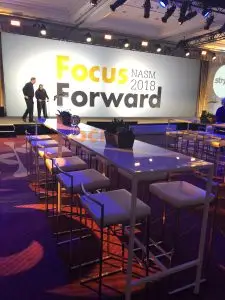
Standing height does something lounge seating cannot: it keeps conversations short and turns the space over faster. Pair a communal bar table with a few bar stools when your goal is volume of conversations rather than depth. It is also the right call in a 10×10, where a sofa would eat the whole booth.
By hour four of day one, attendee phones are dead. Powered lounge and cafe pieces are one of the few honest reasons a stranger will sit down in your booth and stay. Confirm your booth power order in the exhibitor kit — the furniture needs a drop like anything else.
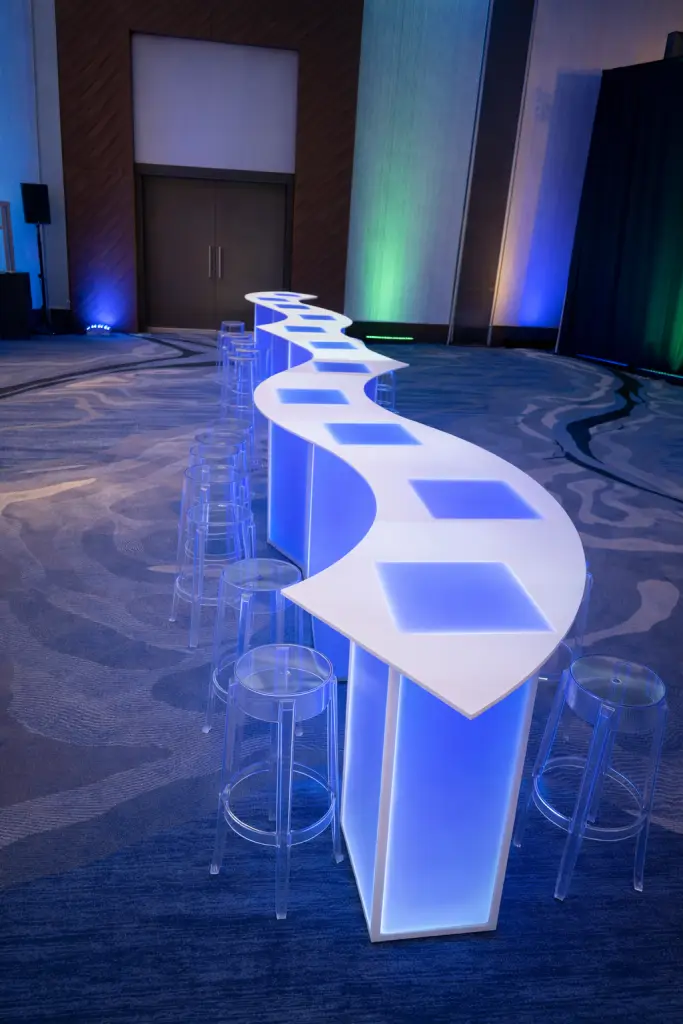
When the neighboring booths are all white hardwall, a lit bar or an illuminated pillar reads from three aisles away. LED furniture, scenic elements, and truss give you height and a focal point without a custom build.
Smaller pulls can still happen inside two weeks. The four-to-six week number is about protecting your first choice, not about whether we can help you at all.
Everything quotes at a daily rate and a multi-day (three to five day) rate, and almost every trade show falls into the multi-day bracket. A typical 10×20 kit — one branded counter, two lounge chairs, a coffee table, and a pair of stools — generally lands around two thousand dollars for a three-to-five day show, before delivery and install. Swap the counter for an illuminated one or add a bar and it moves up from there.
If your team is also handling attendee logistics, Visit Milwaukee is the practical starting point for hotel blocks and downtown transportation around the convention district.
Do you deliver and set up inside the Baird Center?
Yes. We deliver, place, and strike on site, and we work to the move-in and move-out windows in the show’s exhibitor kit. Send us the kit with your booth number and we will build the install around it.
How far in advance should I book trade show furniture in Milwaukee?
Four to six weeks for a large show, which protects your first choice of pieces. Smaller orders are often still possible inside two weeks, so it is worth asking even late.
Can counters and bar faces be branded?
Yes. Many of our counters and bar faces take vinyl branding, and a good deal of the illuminated inventory is fabricated in house. Get artwork to us roughly two weeks before move-in.
Browse the full event rentals collection, or send your booth diagram and show dates to rentals@moderneventrental.com and we will come back with a laid-out furniture plan and a quote.